
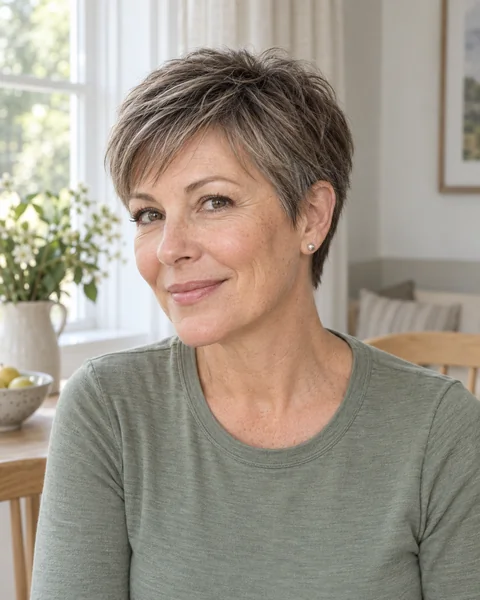

Choosing a short haircut starts with deciding what you want from the shape: more movement, less bulk, room for your curls, or a fringe that sits comfortably with glasses. These short haircuts for women over 50 range from softly tapered pixies to nape-length bobs, with shags, curly cuts, and natural coils in between.
Each idea includes details to discuss with your stylist, such as how much length to leave at the crown, where the ends should fall, and which areas need their fullness preserved. There are options for fine and thick hair, along with silver styles and cuts shaped around natural waves, curls, and shrinkage.
Look for a reference with texture and density similar to yours, then consider both daily styling and salon upkeep. A close crop may take little time to shape each morning while needing frequent trims to maintain its outline.
26 Short Haircut Ideas for Women Over 50 to Find Your Next Shape
1. Soft Tapered Pixie
Ask for a softly blended nape and enough length on top to follow your natural growth direction. Work a small amount of light styling cream through the ends, then finger-shape the fringe. A neat taper needs regular salon upkeep even when daily styling is simple.
2. Piecey Spiky Crop

Keep the spikes short enough to separate with your fingertips instead of building a stiff crest. Warm a little matte paste between your hands and pinch only the tips. Leave the sides softer if you want the texture to feel playful rather than sharply disconnected.
3. Side-Swept Long Pixie

A longer front gives you room to change the part or sweep hair away from glasses. Ask the stylist to keep the fringe connected to the crown so it falls naturally across the forehead. Check the direction of any front cowlick before choosing the part.
4. Over-the-Ear Scissor Crop

Show your stylist exactly how much ear you want exposed. Scissor-cut edges can keep the outline soft while preventing hair from bunching around earring backs or glasses arms. The outline becomes less crisp as it grows, so discuss a trim rhythm you can maintain.
5. Close Textured Crop

Bring a photo that shows the sides as clearly as the front; a close crop leaves little room to hide a shape you do not like. Ask for a soft transition around the crown and natural hairline. Daily shaping can be minimal, but the exact outline will change noticeably as it grows.
6. Undercut Quiff Pixie

The contrast comes from short sides beneath a longer top, so ask how the cut will look as the undercut grows out. Lift the front with a small brush and keep the quiff modest if you prefer easy reshaping. This is a higher-upkeep option than a softly blended pixie.
7. Pixie with Wispy Bangs

A wispy fringe needs only a small section of hair, which helps avoid taking too much density from the top. Ask for soft ends rather than a solid heavy line. Dry the fringe in its intended direction before it sets, especially if your hairline has a cowlick.
8. Glasses-Friendly Pixie

Wear your everyday frames to the appointment so the fringe can be checked against the top rim. Keep the temple sections from pushing into the glasses arms, especially if you tuck them repeatedly. A short side sweep leaves the lenses clear without requiring a bare forehead.
9. Rounded Bixie

Ask for a rounded crown that narrows into a short nape while keeping enough length around the ears to tuck. The balance matters: too much weight at the sides can make a bixie feel bulky. This is a useful reference if you want a cropped shape but still enjoy some bob-like movement.
10. Blunt Chin-Length Bob

A strong bottom line can make fine ends look more substantial. Ask for minimal layering if you want that solid outline, and compare the chin-length reference with your own jawline before cutting. Tucking one side gives a quick change without altering the shape.
11. Graduated Nape Bob

Ask the stylist to show you the back with a mirror before the appointment ends. The shorter nape and graduated back create the shape, while longer front sections keep movement around the face. Avoid excessive stacking if your hair is sparse at the crown.
12. Angled Jaw-Length Bob

Longer front corners can create a more vertical outline if that is the effect you want around a round face. Ask for a gentle forward angle rather than an extreme slope, and keep the layers light enough to preserve the edge. Face shape is a preference cue, not a rule you need to follow.
13. French Bob with Soft Fringe

Check the length with your hair dry so the bob does not spring shorter than you expect. A softly broken fringe can feel less rigid than a perfectly straight line. Let a little natural bend remain through the ends if you prefer a relaxed finish.
14. Airy Layered Bob

Ask for a few long surface layers while keeping the bottom edge fairly full. Fine strands can lose their outline if too much hair is removed, so bring a reference with similar density. A small amount of lightweight mousse can support movement without a heavy coated finish.
15. Sculpted Bob for Thick Hair

If a short bob expands at the sides, ask about removing weight inside the cut while preserving the outer shape. The amount depends on your strand texture and how your hair settles dry. A smooth finish takes more styling than the photograph alone suggests, so discuss your usual routine.
16. Soft Wavy Bob

Let the natural wave help decide where the ends should sit. Apply a light defining product to damp hair, scrunch gently, and leave the pattern alone while it sets. Ask for a dry shape check so one side does not jump noticeably shorter than the other.
17. Choppy Fine-Hair Shag

For fine hair, ask for a restrained shag with a visible bottom line rather than heavily thinned ends. Shorter crown layers and a broken fringe create the shag effect without removing weight everywhere. Choose a reference with realistic density so the finished cut matches what your hair can do.
18. Feathered Short Shag

Feathered layers need enough length to turn away from the face. Ask where the shortest layer will fall before agreeing to the cut, especially around the cheekbones. Direct the ends outward with a small brush if your natural growth pattern does not create that movement on its own.
19. Curly Tapered Pixie

Choose the top length by how your curls sit dry, not by stretching them down. Keep enough length for the curl to form while tapering the sides to control the outline. Define small sections gently and avoid brushing through the finished dry curls if you want to keep their shape.
20. Lightly Layered Curly Bob

Keep layering conservative if your curls are becoming sparse, particularly around the ends. Ask the stylist to assess the shape dry and preserve the areas that give the bob its outline. Use a light hold product sparingly so the curls stay separated without looking coated; the cut changes appearance, not hair density.
21. Rounded Silver Curl Bob

A rounded shape works best when the layers follow the way your curls naturally stack. Ask the stylist to balance the sides while keeping the ends from spreading into a triangle. Keep a few front curls loose if you prefer movement around your face instead of a fixed fringe.
22. Side-Parted Curly Bob

Move the part slightly off center if you want a more asymmetric outline around a round face. Keep the front curl length long enough to fall beside the cheek rather than stopping at its widest point. Test the part on your own dry curls before changing the cut.
23. Curly Shag with Fringe

Have the fringe checked at its dry resting length so the shortest curls do not land higher than you intended. Crown layers give this shag movement, while a longer nape keeps the outline relaxed. Refresh only the flattened curls instead of soaking the entire style every time.
24. Tapered Natural Coils

Ask for the silhouette to be assessed in the way you normally wear your coils, including their shrinkage. Keep enough crown length for definition while tapering the sides gradually. Detangle gently while conditioned, then shape with your fingers instead of pulling the finished coils apart repeatedly.
25. Rounded Mini Afro

A compact rounded afro gives you a different shape from a tapered cut while keeping the hair short. Ask for shaping in its natural dry state and preserve the hairline rather than forcing a sharp geometric edge. Lift gently at the roots only where needed to even the silhouette.
26. Soft Nape-Length Bob

If you are moving from longer hair, a nape-length bob lets you try a shorter outline while keeping some tuckable length. Confirm that the finished ends sit clear of the shoulders so the cut still feels short. A soft side part and light end shaping make this an adaptable starting point before a later pixie.